
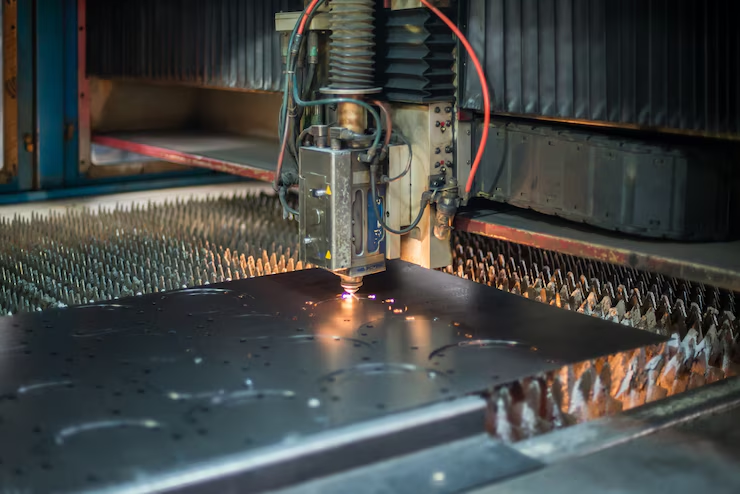

Precision isn’t just about clean lines—it’s about doing the hard jobs with ease, speed, and accuracy. Metalwork in Alabama has hit a new level thanks to CNC plasma technology that handles complex angles and thick plates without blinking. Whether you’re building industrial parts or custom-fitted steel structures, here’s how Alabama CNC plasma cutters are changing the game.
Five-axis CNC Profiling Enabling Angular Bevels and Chamfers
Standard cutting doesn’t cut it when the job demands beveled edges or angular finishes. That’s where five-axis CNC profiling steps in. With advanced tilt and pivot capabilities, the torch can rotate smoothly to shape metal at sharp angles—producing clean chamfers and compound bevels without needing secondary machining. This saves hours of work and keeps tolerances tight from the first pass.
An Alabama plasma cutter with five-axis control can handle beveling tasks like weld-prep with accuracy measured in tenths of a millimeter. These profiles are critical in structural steel joints where strength relies on precision edges. For companies offering CNC machining in Alabama, this technology takes once-complicated projects and simplifies them into streamlined, one-step processes—especially important in aerospace and robotics engineering projects.
Dynamic Torch Rotation for Tube and Section Cutting
Curved pipes and structural tubing don’t follow a flat plate’s rules. Dynamic torch rotation makes it possible to rotate and cut round or irregular profiles with a continuously adjusting torch head. The arc stays perpendicular to the surface no matter the geometry, giving perfect circular or diagonal cuts on tubes, elbows, and H-beams.
For any robotics engineering company in Alabama working with metal frameworks, this means reduced labor and tighter integration of parts. With this feature, the CNC plasma cutter in Alabama doesn’t just cut through materials—it moves intelligently across shapes and contours. It’s like having a robotic welder and metal shaper rolled into one, engineered for fast, flawless cuts.
3+ Axis Angular Cutting Producing Weld-Ready Edges
Weld-ready edges aren’t just smooth—they’re angled for perfect joins. With 3+ axis angular cutting, the torch can carve edges that are tailored for welding processes like MIG or TIG. This means no need for post-cut grinding or edge prep, which is a big time-saver in heavy-duty fabrication.
The Alabama CNC plasma cutter shines here by delivering edges with repeatable accuracy. Whether it’s carbon steel or stainless, the edge geometry comes out just right for high-strength welds. For industries where strong joints are everything—like construction, shipping, or precision frames—this feature transforms how plates are divided and prepped.
High-Speed Plasma Pathing Minimizing Plate Distortion
Heat distortion used to be a major problem in plasma cutting. High-speed pathing has changed that. By reducing dwell time over hot zones, this feature keeps plates flat even under intense cutting conditions. The result? Less warping, less scrap, more usable product.
An Alabama plasma cutter with this level of control makes it possible to cut intricate patterns on thinner materials without affecting their integrity. For Alabama-based CNC machining operations, this means more consistent parts per run and fewer manual corrections, making production faster and more reliable.
Automated Torch Height Control Optimizing Cut Consistency
The torch’s distance from the metal surface is everything in plasma cutting. Automated torch height control adjusts that distance in real time—even if the plate isn’t perfectly flat. Sensors scan and react instantly to changes in surface elevation, keeping the arc stable from start to finish.
This ensures that the Alabama CNC plasma cutter delivers uniform kerf width, cleaner edges, and less dross. In high-volume environments or with inconsistent stock, this technology protects against errors that slow down production. It’s a must-have for CNC machining in Alabama where consistency and accuracy can’t be compromised.
Dual-Gas Pilot Arc Technology for Crisp Kerf in Thick Plates
Cutting thick steel is tough, but dual-gas pilot arc systems make it precise. By using a two-gas system—typically a combination of oxygen and nitrogen or argon—the pilot arc can burn cleanly through dense material. This produces a narrow kerf and reduces slag buildup on the bottom edge.
For any robotics engineering company in Alabama or structural shop handling heavy-grade steel, this tech adds serious capability. The cut faces stay crisp even on plates over 2 inches thick, allowing tight fitting of parts without the need for further edge cleanup. It also reduces electrode wear, keeping tools running longer and sharper.
Inverter-Controlled Plasma Arc Delivering Clean 150 mm Cuts
Power and control often don’t mix—but inverter-controlled arcs balance both. These systems adjust voltage and current on the fly, providing stable, clean arcs even through 150 mm thick materials. That’s five inches of solid steel sliced with surgical smoothness.
Alabama plasma cutter systems with inverter control bring flexibility and brute strength together. They’re ideal for cutting exotic alloys or massive industrial components, something standard machines struggle with. For CNC plasma cutter in Alabama jobs that push the limits, this feature ensures cuts stay true, no matter how thick the plate gets.